

Rubrik Zero Labs presents insights from late September through late October 2026, highlighting critical shifts in the cybersecurity landscape. All threat intelligence relevant to threat detection is available via the Rubrik Zero Labs threat feed for detection in Rubrik products.
Rubrik Zero Labs Monthly Highlights
Rubrik Zero Labs recently published a detailed blog post on the evolving landscape of cloud-native malware by GraphFleet, a sophisticated 64-bit Windows backdoor abusing legitimate Microsoft 365 infrastructure for command-and-control operations. Major highlights include:
- Abuse of Microsoft Graph for Cloud-Native C2: Rather than communicating with attacker-owned servers, GraphFleet authenticates with stolen OAuth refresh tokens to masquerade as Microsoft Teams and blends malicious traffic into legitimate enterprise requests. It exchanges commands and outputs through hidden Microsoft Graph open extensions on Calendar events, leaving no visible trace in standard Outlook or Teams user interfaces.
- Resilient Multi-Tiered Fallback and Remote Recovery: If its primary Calendar channel fails, the implant automatically cycles through secondary C2 mechanisms, including Outlook Drafts, Microsoft To Do tasks, and OneDrive app-folder files. To maintain persistent access, GraphFleet stores tokens in a local DPAPI cache tied to the host and can recover replacement tokens from a hardcoded SharePoint location or via read-only calls to a BNB Smart Chain smart contract.
- In-Memory Payload Delivery and Privileged Persistence: Operators maintain broad control over infected systems, with capabilities to execute arbitrary shell commands, download files, run scripts inside an internal virtual machine, and load shellcode or 64-bit PE payloads directly into memory. GraphFleet can establish persistence across user-level startup scripts and registry keys, as well as a privileged persistence mechanism utilizing the Windows Print Spooler and custom print processors.
Major Stories of the Month
- PHP2Shell AI-Discovered Unauthenticated RCE Vulnerabilities (CVE-2026-109618 / CVE-2026-109619)
- Two critical CVSS v4.0 9.2 vulnerabilities (“PHP2Shell”) in PHP (versions 5.4 through 8.5) were discovered with the assistance of OpenAI frontier models (GPT-5.6 Sol, used by a Calif researcher; Wiz independently found them too), enabling unauthenticated remote code execution across server-side web infrastructure, in some configurations (notably Apache mod_php) before application code executes.
- PHP powers approximately 70% of websites using server-side languages. Censys telemetry identified 2.58 million internet-exposed PHP hosts, and VulnCheck estimates 42% run end-of-life (EOL) PHP versions receiving no official security patches.
- Amazon recorded an exploitation attempt on its honeypot network beginning October 17, four days prior to public disclosure. Within hours of the October 21 patch release, Cloudflare recorded millions of exploit attempts. Dutch and Finnish public sector institutions took online government services offline preemptively. Threat actors subsequently chained PHP2Shell with Linux kernel privilege escalation (CVE-2026-46300, “Fragnesia”) to achieve root access on about 25 internet-exposed servers, mostly firewalls, including at a U.S. government-affiliated organization (per Dream Security).
RZL Assessment: Exploitation is technically difficult and highly target-dependent. It requires precise heap manipulation and an ASLR bypass, and public proof-of-concept exploits have proven unreliable in testing. Mass exploitation has been limited, but targeted attackers have built working custom exploits, including against appliances such as Palo Alto Networks firewalls. Patching remains essential.
- ConnectWise Supply Chain Compromise Targeting 2,250+ Microsoft 365 Tenants
- Threat actors obtained unauthorized access to ConnectWise Cloud Backup (formerly SkyKick) application identities and used a stolen app credential (OAuth client credentials flow) to authenticate as the application into customer Microsoft 365 tenants, bypassing user MFA.
- Huntress confirmed unauthorized sign-ins in 173 partner and customer Microsoft 365 tenants as of October 17 (162 the previous day). Microsoft counted sign-in attempts against more than 2,250 tenants globally, most of which failed.
- Microsoft assesses the operation was carried out by China state-aligned threat group Storm-0940, which used the open-source ARTEX multi-agent AI pentest framework to accelerate reconnaissance, password spraying and OAuth app abuse. Some intrusions reached privileged cloud access in under three hours. ConnectWise shut off Cloud Backup access on October 17 and also suspended SaaS Security and Cloud Management on October 18 as a precaution.
- Microsoft Record-Breaking 1,413-Vulnerability Patch Tuesday & Windows Shell Zero-Day (CVE-2026-96951)
- Microsoft’s October 2026 Patch Tuesday (released October 13) addressed 1,413 CVEs according to Microsoft’s published total, the largest monthly release on record and up from September’s prior record of roughly 1,000. Counts vary slightly by tracker (about 1,407 to 1,417). Windows products account for about 78% (1,102) of the fixes.
- The release fixed CVE-2026-96951 (CVSS 8.8), an actively exploited Windows Shell command injection flaw classified as a security feature bypass, which allows unauthorized attackers to bypass Mark of the Web protections using crafted files.
- CISA added CVE-2026-96951 to the KEV catalog on October 13 with a three-day federal remediation deadline (October 16). The release also included many critical remote code execution fixes across network services including DNS Server, DHCP and RRAS.
Top Ransomware Groups
Note: Ransomware operations throughout October 2026 demonstrated significant acceleration in AI augmentation, systematic zero-day exploitation of enterprise network edge and VPN infrastructure, and persistent targeting of critical national infrastructure.
- INC Ransom – Affiliates of INC and The Gentlemen exposed seven servers holding 8,257 AI messages across 133 sessions (over $23,900 in AI API spending) and 46 custom INC encryptor builds (Windows and Linux) prepared for six victims. About 62 organizations were targeted across the operation, four of which appeared on leak sites. INC’s Windows and Linux/ESXi encryptors are Rust-based. INC affiliates exploited PAN-OS CVE-2026-0257, a GlobalProtect authentication bypass (MFA bypass) patched May 13, against unpatched devices. INC claims 500GB of data from South Africa’s BCX, including source code, which BCX has not confirmed.
- Qilin – Exploited CVE-2026-0257 since June to bypass MFA, per Arctic Wolf and Unit 42. A suspected core member was detained in Japan in May and extradited to Germany in October over a 2024 attack on a logistics company. The group remained active.
- The Gentlemen – A top-activity RaaS group (about 600 leak-site claims worldwide in 2026 through July, and the most active group in Japan in H1). Its affiliate infrastructure overlapped with INC’s AI tooling (Phantom, Ghost C2). An affiliate ran a parallel leak site and kept extortion proceeds.
- SafePay – A joint CISA/FBI advisory says it has impacted at least 600 critical infrastructure victims since August 2024.
- Warlock (China-nexus) – Exploited SharePoint ToolShell vulnerabilities against at least four organizations in Portuguese- and Spanish-speaking countries (water, telecom, government, university), using EDR killers and SYSVOL staging.
Linux / Cloud / Identity Attacks: Top Threats
These threats are prioritized based on their critical severity (CVSS scores), immediate widespread impact, and observed mass exploitation in enterprise environments.
- Linux Kernel Rootkits & Hypervisor Isolation Escapes (CVE-2026-99999 "PwnEscape" & Kernel Systemd Backdoors)
- Type: Linux Kernel & Cloud Virtualization Infrastructure
- Impact: CVE-2026-99999 (“PwnEscape”) is a Linux kernel networking flaw (IPv4 packet handling) that lets code in a guest VM leak host kernel memory (about 32 bytes per packet), crash the host, and in lab conditions run code as root on the host. CVE-2026-74580 (“Vghost”) is a flaw in the Linux vhost subsystem (kernels 4.11 through 7.2-rc4) that lets local users with vhost device access read and write kernel memory and reach root, with a conditional guest-to-host path. Neither has reported in-the-wild exploitation.
- Statistics: PwnEscape is rated CVSS 9.3 (Critical), found during Vercel’s Sandbox challenge and fixed in stable kernels October 15. Vercel confirmed the host-memory leak against its production sandboxes. Vghost is rated CVSS 8.8 (High), patched August 3, with full technical details published October 12.
Insights from Rubrik Zero Labs LLM Powered Advanced Analysis Systems
Top Threats Inside Backups: Our advanced analysis systems identify top and trending threats seen in the wild and compare that data with backup telemetry to detect stealthy malware. In this section we present the data for this month.
Beyond the Front Line
5.8% of prevalent threats are identified with high confidence as having bypassed front-line defenses. Behind that cohort stands a small set of named adversaries, each with a distinct catalogue of tooling whose activity accumulated evidence in environments where successfully-contained threats do not leave a trail. 64.1% of named campaigns tied to the bypass cohort carry adversary attribution: a named operator stands behind the tooling. The cohort's footprint concentrates in Food & Beverage, Healthcare, and Education, with operators deploying tooling that ranges from ransomware to credential theft to privilege escalation exploits.
UNC6692:
| Industry | Share of cohort footprint |
|---|---|
| Professional services | 100% |
The operator's tooling for this period includes browser-based persistence mechanisms. SNOWBELT accounts for 0.3% of the bypass cohort's alert activity. SNOWBELT is a browser extension-based backdoor written in JavaScript that facilitates communication with its Amazon Web Services (AWS) S3 bucket-hosted command-and-control infrastructure.
SafePay:
| Industry | Share of cohort footprint |
|---|---|
| Technology | 100% |
The operator's tooling for this period focuses on ransomware deployment. SAFEPAY represents 0.1% of the bypass cohort's alert activity. SAFEPAY is ransomware malware written in C++ that enumerates local and network drives to encrypt files using AES-256 in CBC mode.
Sector composition of the high-confidence bypass cohort, shown as share of cohort-wide environment footprint.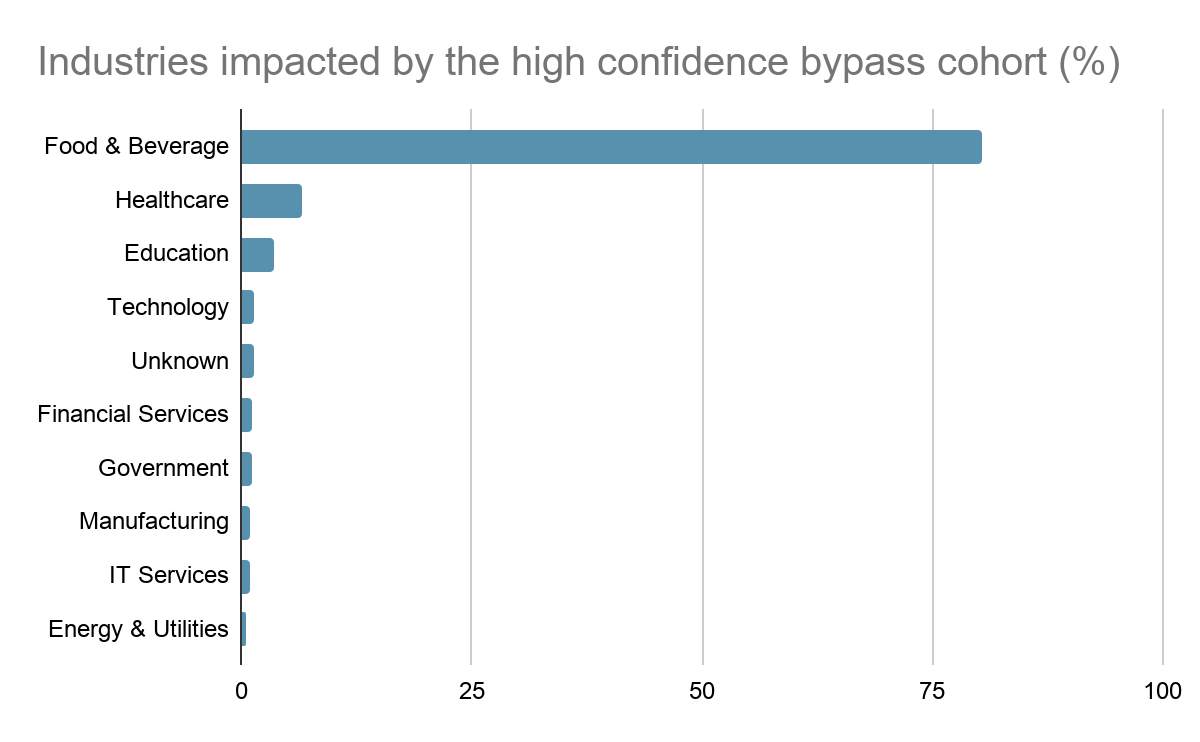 Ransomware
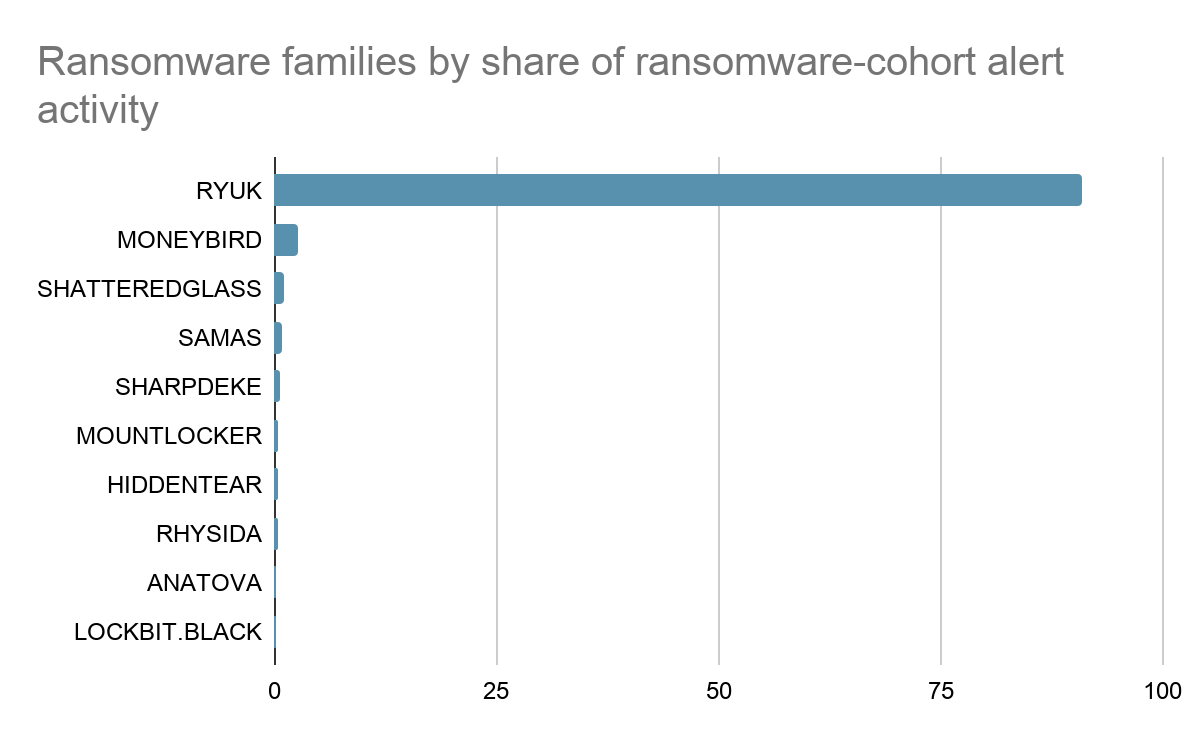
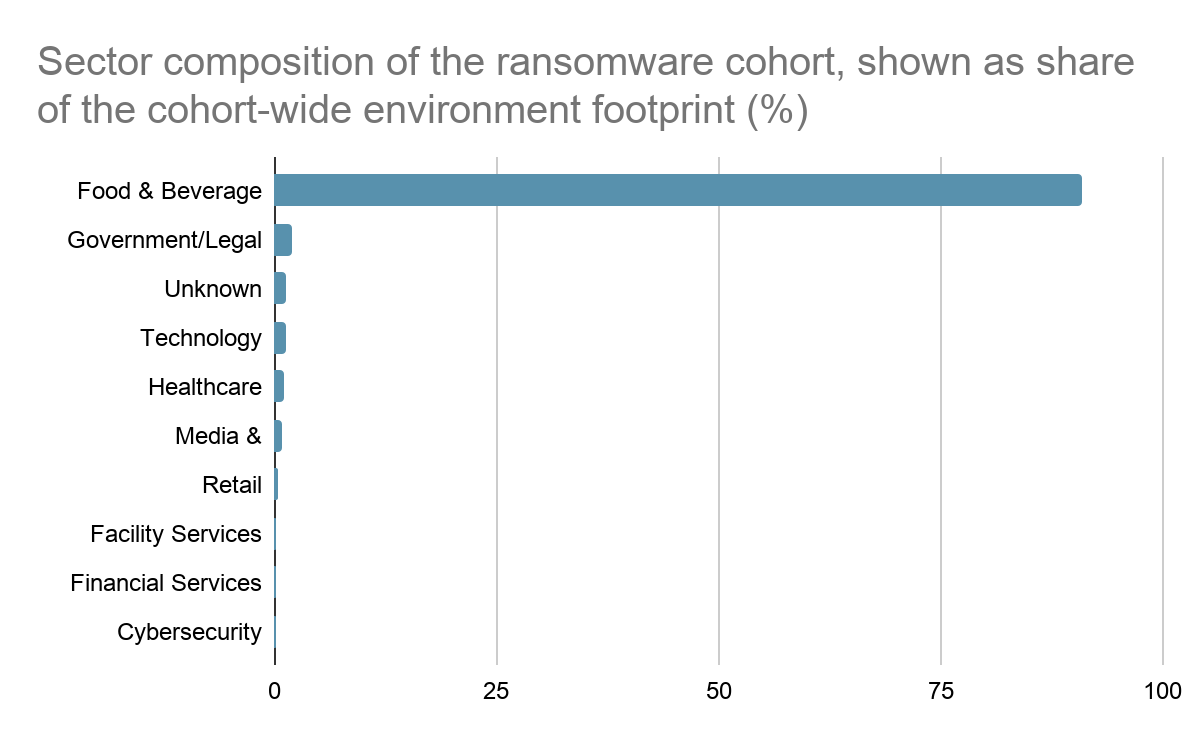
8.6% of identified threats this period were ransomware families. The period's ransomware activity concentrated in Food & Beverage (91%), with Government/Legal Services (2%) and a long tail of other sectors accounting for the remainder. The Food & Beverage dominance is a sharp departure from typical ransomware distribution patterns, which tend to spread more evenly across Healthcare, Financial Services, and Manufacturing. The concentration suggests either a campaign-specific targeting preference or a detection artifact where a single operator's activity in that sector generated disproportionate alert volume. Government/Legal Services - a sector where MOUNTLOCKER appeared exclusively - represents the second-largest share, consistent with ransomware operators targeting environments where regulatory exposure and data sensitivity amplify extortion leverage.
LATEST BLOGS